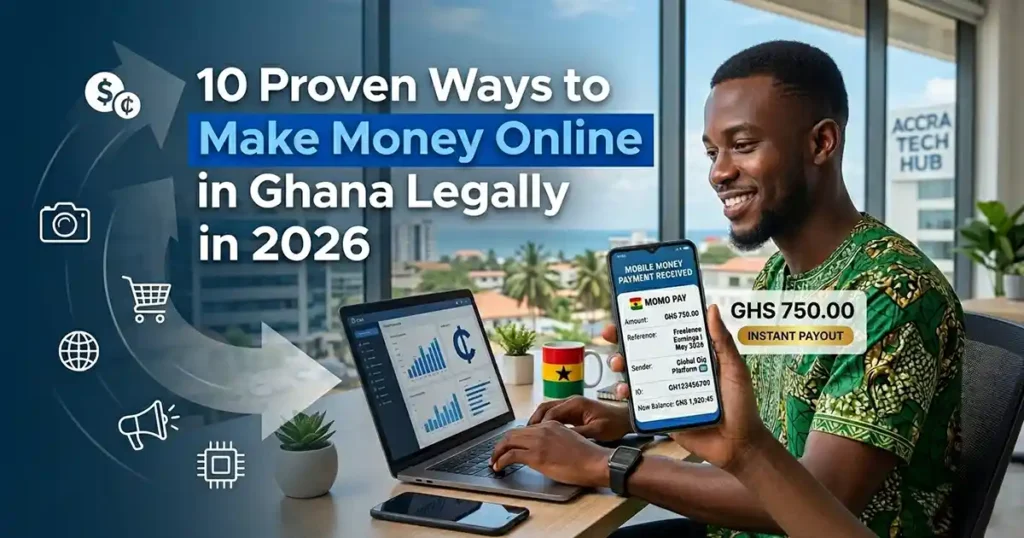
10 Proven Ways to Make Money Online in Ghana Legally in 2026
Almost every week, someone messages me on WhatsApp asking the same question: "Is it really possible to make money online in Ghana, or is it all scams?" I understand the…


Almost every week, someone messages me on WhatsApp asking the same question: “Is it really possible to make money online in Ghana, or is it all scams?”
I understand the doubt. Most of us have seen the “invest GHS 50 and get GHS 5,000” groups, or a relative who lost money to some shiny platform that vanished overnight. So let me be clear from the start: this article is not about any of that.
What I’ve put together here are ten ways Ghanaians are genuinely earning online right now — through actual work and actual skills. Some of these I’ve done myself, others I’ve watched my own students at Ovateq do. None of them will make you rich by Friday. All of them are real.
Table of Content
Table of Contents
Why Making Money Online in Ghana Is More Viable Now Than Ever
A few years ago, two things killed most people’s online ambitions before they started: unreliable internet and no way to get paid. Both problems have largely been solved.
Data is cheaper than it was in 2018, and MTN MoMo, Telecel Cash, and AT Money have made receiving money almost effortless. On top of that, Payoneer and Wise both work in Ghana now — meaning a client in London or Toronto can pay you in pounds or dollars, and it lands in an account linked to your MoMo wallet. When I started out, that alone felt impossible.
The skills gap is closing too. Between TVET programs, university courses, bootcamps, and training platforms like ours at Ovateq, more Ghanaians than ever have skills that international clients will pay for.
If you have a smartphone, a decent data connection, and at least one skill someone else needs, you can earn online legally from Ghana. Here is how.
1. Freelancing
Freelancing is probably the most direct path. You offer a skill, someone pays you for it, you deliver the work.
The skills in highest demand internationally right now are graphic design, web development, copywriting, video editing, virtual assistance, data entry, social media management, and translation.
The main platforms are Upwork, Fiverr, and Toptal. Fiverr works better for beginners because you create a listing and clients come to you. Upwork requires you to pitch for jobs, which is harder at first but tends to pay better over time.
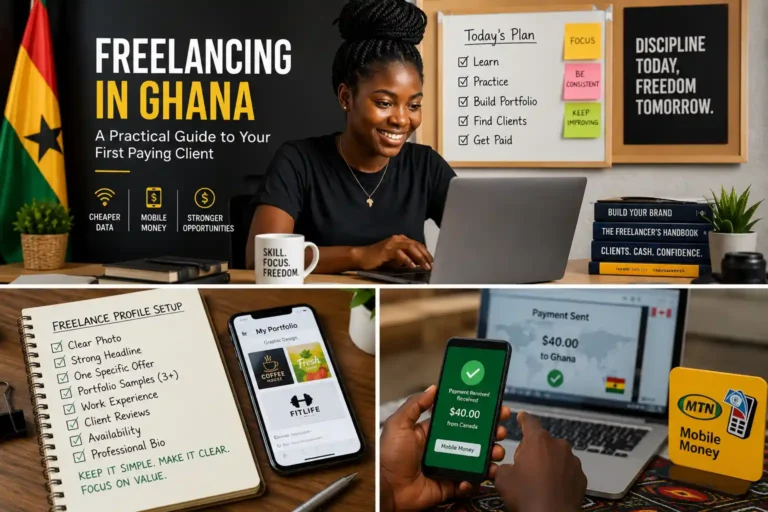
What you need: a completed profile, at least two or three portfolio samples (even if unpaid), and patience in the first month. The first client is always the hardest to get. After that, reviews build on reviews.
Payment comes through Payoneer, which connects to mobile money in Ghana.
2. Selling on Jumia and Tonaton
E-commerce in Ghana is growing. Jumia is the largest online marketplace, and Tonaton handles a large volume of secondhand and new goods. Both let you list products and reach buyers across the country without a physical shop.
What sells: electronics and accessories, fashion and shoes, cosmetics and skincare, food products, and handmade crafts.
The business model is simple. You source products — either locally, from Accra’s markets, or from China via Alibaba — and list them at a markup. Delivery is handled either by you or through Jumia’s fulfilment system.
This is not passive income. It requires active management, customer communication, and restocking. But the startup cost can be very low if you begin with what you already have or can source locally.
3. Content Creation (YouTube and TikTok)
Ghanaian creators are making real money on YouTube and TikTok. Not all of them, and not overnight — but the ones who commit to a niche and post consistently.
YouTube pays through AdSense once you hit 1,000 subscribers and 4,000 watch hours. TikTok’s creator programme pays less per view, but growth there can be faster.
What works in Ghana: tutorials in Twi or Pidgin, food and recipe content, travel and lifestyle, tech reviews, finance tips for Ghanaians, and comedy skits.
The barrier is lower than people think. A decent phone camera and natural lighting are enough to start. The real barrier is consistency — most channels that fail do so because people stop posting after two months.
4. Affiliate Marketing
Affiliate marketing means you promote someone else’s product, and when someone buys through your link, you earn a commission.
In Ghana, the most accessible affiliate programs are the Jumia Affiliate Program (pays in cedis, easy to join), Amazon Associates (pays in dollars, requires a website or strong social media presence), and digital product platforms like ClickBank and Digistore24.
You don’t need a website to start, though it helps long-term. A Facebook page, a TikTok account, or a WhatsApp channel with an engaged following can drive affiliate sales.
What you need to be honest about: affiliate marketing takes time. People who claim to make GHS 5,000 in their first week are either lying or selling you a course. Most people who stick with it for six to twelve months start seeing consistent commissions.
5. Blogging
Blogging is one of the slowest but most durable ways to make money online in Ghana.
A blog earns money through AdSense ads, affiliate links, sponsored posts, and digital product sales. It is slow to start — Google typically takes three to six months to rank new content — but it compounds over time.
Niches that work well for Ghanaian bloggers targeting local traffic: personal finance in Ghana, health and wellness, food and recipes, education and scholarships, and tech tutorials.
For international traffic, write in English and target topics that Ghanaians and diaspora communities search for.
The technical setup is inexpensive. A domain costs about GHS 150–200 per year. Hosting from providers like Namecheap, or a local Ghanaian host like Web4Africa, runs from GHS 300–600 per year. WordPress itself is free.
Rank Math, an SEO plugin (which this blog itself uses), helps new bloggers optimize content for Google without needing to understand SEO deeply.
6. Online Tutoring and Teaching
If you know something well — math, English, science, coding, music, a trade skill — you can teach it online and get paid.
Platforms like Preply, iTalki, and Teachable let you create courses or offer one-on-one sessions. Locally, you can tutor students via Zoom and advertise in Facebook groups or on community notice boards.
The demand for English tutoring from non-native speakers (in Asia and Latin America especially) is consistent. If your English is strong and you enjoy teaching, this is one of the more reliable income streams available from Ghana.
You can also create and sell courses on Selar — a Nigerian-founded platform widely used in West Africa that lets you sell digital products and courses in cedis.
7. Transcription and Data Entry
These are entry-level online jobs. They don’t require specialized skills, but they do require accuracy, attention to detail, and reasonable typing speed.
Rev.com pays for audio and video transcription work. The rates are not high (around $0.45–$0.75 per audio minute), but work is available consistently. Scribie and TranscribeMe are alternatives with lower barriers to entry.
Data entry work shows up on Upwork, Fiverr, and remote job boards like Remote.co and We Work Remotely.
These won’t make you rich. But they are a realistic way to earn your first online income while building a stronger skill set in parallel.

8. Social Media Management
Most small businesses in Ghana — and internationally — need someone to run their Instagram, Facebook, or TikTok. Most owners don’t have the time, knowledge, or interest to do it themselves.
If you understand how social media algorithms work, can write engaging captions, design basic graphics in Canva, and post consistently, you can offer this as a service.
Rates vary widely. Local Ghanaian businesses pay GHS 300–800 per month for basic management. International clients on Upwork pay $300–$800 per month for the same work.
Start by managing one account for free (a friend’s business, a community page) to build a portfolio, then pitch paying clients.
9. Selling Digital Products
Selling digital products is one of the most scalable ways to make money online in Ghana.
Digital products cost nothing to replicate once created. You make it once and sell it repeatedly.
What sells: CV and resume templates, business plan templates, social media content calendars, e-books, study guides, Canva graphic packs, and Excel budget trackers.
Selar and Gumroad are the two most practical platforms for Ghanaians. Selar supports mobile money payments directly, which makes it easy to sell to other Ghanaians.
The hardest part is the first sale. After that, an audience or mailing list makes each new product launch easier.
10. Remote Customer Service and Virtual Assistant Work
Companies in the US, UK, Canada, and Australia regularly hire remote workers for customer support, inbox management, scheduling, research, and admin work. Ghana’s timezone works especially well for UK-based companies.
Job boards to check: Remote.co, FlexJobs, LinkedIn Remote Jobs, and Jobgether. Search specifically for “remote customer service,” “virtual assistant,” and “remote admin.”
Pay starts around $5–$8 per hour for entry-level roles and rises with experience. Many of these positions offer flexible hours.
What you need: reliable internet, a quiet working environment, professional written English, and basic computer skills.
How to Receive Online Payments in Ghana
This is the question that stops many people before they start. The answer is more straightforward than it used to be.
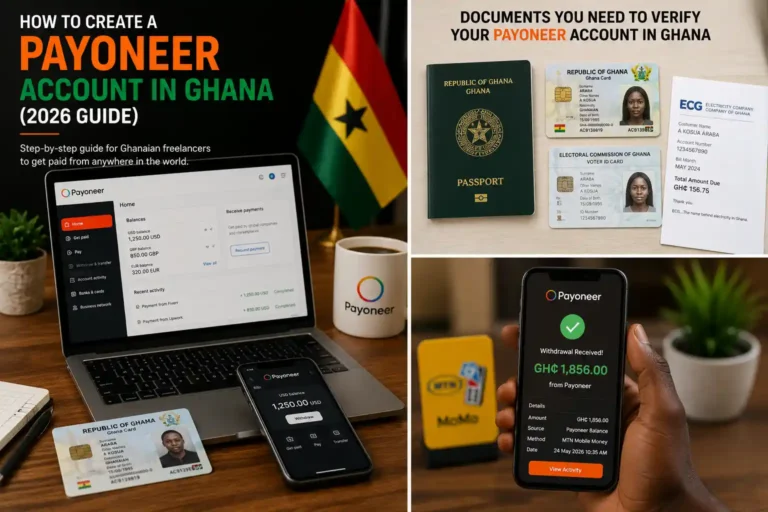
Payoneer is the most widely used option. You get a US bank account number, receive payments from international platforms and clients, and withdraw to MTN MoMo or your Ghanaian bank account. Payoneer registration is free.
Wise is a good alternative with often better exchange rates, though setup takes slightly longer. Both are legal and widely used.
What to Avoid
Some things that look like online income opportunities in Ghana are not.
Ponzi schemes in any format — anything where you earn by recruiting others, where returns are guaranteed regardless of market conditions, or where the product is the recruitment itself. These are illegal under Ghana’s Securities and Exchange Commission regulations and routinely collapse.
“Investment” platforms promising fixed returns of 20–50% per month. No legitimate investment works this way.
Paid surveys as a primary income stream. They pay too little to be worthwhile, and many are scams.
The legal ways to make money online in Ghana require work. That is not a disadvantage — it is what makes them real.
How to Start Making Money Online in Ghana Without Spending Money
You do not need to spend money to start making money online in Ghana. Here is the zero-budget path:
- Pick one skill from this list that matches something you already know or can learn free on YouTube.
- Create a free Fiverr or Upwork profile.
- Build two to three portfolio samples — even unpaid practice work counts.
- Apply to five jobs or create your first gig listing.
- Set up a free Payoneer account to receive payment when it comes.
That is the whole starting process. The only investment required is time.
Frequently Asked Questions (FAQs)
Frequently Asked Questions (FAQs)
Is it really possible to make money online in Ghana legally?
Yes – and a lot of people are already doing it. Freelancers, bloggers, content creators, tutors, and e-commerce sellers across Ghana earn real income online every month. The difference between them and people who tried and gave up is usually consistency, not talent. The legal methods require actual work, but they are real.
What is the easiest way to make money online in Ghana for beginners?
Transcription and data entry are the most accessible starting points because they don’t require specialized skills — just accuracy, attention to detail, and a reliable internet connection. Platforms like Rev.com and Scribie have relatively low barriers to entry. That said, the pay is modest. If you have any marketable skill at all — design, writing, teaching, even social media — you will earn more starting there.
How do I receive international payments in Ghana?
Payoneer is the most practical option for most Ghanaians. It gives you a US bank account number that international clients and platforms can pay into, and you withdraw to MTN MoMo or your Ghanaian bank. Registration is free. Wise is a good alternative with often better exchange rates, though setup takes slightly longer. Both are legal and widely used.
How much can I realistically earn making money online in Ghana?
It depends entirely on what you do and how seriously you take it. A Fiverr beginner might earn GHS 500–1,000 in their first month. An experienced freelance developer or designer can earn $1,000–$3,000 per month from international clients. A successful YouTuber or blogger can build passive income that grows over years. There is no fixed ceiling, but there is no guaranteed floor either – it takes work.
Do I need a laptop to make money online in Ghana, or can I use a phone?
Many online income methods work on a smartphone. Social media management, content creation, affiliate marketing on WhatsApp or TikTok, and even basic data entry can be done from a phone. A laptop expands your options significantly — especially for freelancing in writing, design, development, and virtual assistant work. If you’re starting with only a phone, start with what your phone can do and save toward a laptop.-
Is online freelancing in Ghana taxable?
Yes. Income earned online is subject to Ghanaian tax law. The Ghana Revenue Authority (GRA) treats online income the same as any other self-employment income. If you earn above the tax threshold, you are expected to register as a self-employed individual and file taxes. Many freelancers in Ghana do not do this yet, but the GRA has been increasing enforcement of digital income reporting. Register, file, and stay on the right side of it.
Which platforms work best for Ghanaians to sell digital products?
Selar is the most Ghana-friendly option — it supports MTN MoMo and other mobile money payments directly, making it easy to sell to other West Africans. Gumroad works well for selling to international customers and pays via PayPal or direct bank transfer. For courses specifically, Teachable and Thinkific are solid options if you’re targeting international students.
How do I avoid online money-making scams in Ghana?
A few rules that hold up: if it requires you to recruit others to earn, it is a pyramid scheme. If it promises guaranteed returns of more than 10% per month, it is a scam. If you have to pay to access jobs or clients, walk away. Legitimate freelance platforms are free to join. Legitimate affiliate programs are free to join. Legitimate employers do not ask you to send money first. When in doubt, search the platform name plus “scam” or “review” before signing up.
Final Thought
Here is what I tell my students at Ovateq: the internet does not care where you are from. A web developer in Kumasi and a web developer in London can compete for the same job on Upwork — and the one with the better portfolio and reviews usually wins. Your location stopped being an excuse a long time ago.
What I’ve seen over and over is that the people who succeed online are not the smartest or the most talented. They are the ones who picked one method from a list like this, ignored the shortcuts, and kept showing up for six months while everyone else quit in week three.
Pick one. Start this week. And if you get stuck, you know where to find us.
Published on Ovateq — practical skills, real opportunities.
Hi, I’m Ovadia, the founder of Ovateq. I’m passionate about technology, digital skills, and helping people learn practical tools that can improve their careers, businesses, and everyday lives. Through Ovateq, I create beginner-friendly tutorials and educational content focused on Microsoft Office, digital literacy, website development, and modern tech skills. My goal is to make technology easier to understand and more accessible for everyone.

Pingback: Adobe Photoshop Skills in Ghana: 7 Skills That Pay in 2026