7 Powerful Ways to Turn Education Into Success (Most People Ignore in 2026)
My uncle finished secondary school in 1983. He had good grades. He was sharp with numbers. But he couldn't find a formal job for nearly three years. What changed things…

My uncle finished secondary school in 1983. He had good grades. He was sharp with numbers. But he couldn’t find a formal job for nearly three years. What changed things for him wasn’t another certificate — it was a neighbour who taught him basic bookkeeping. That skill, not his exam results, got him hired at a trading company in Accra.
I tell this story because the conversation around education in Ghana is often about degrees, credentials, and certificates. And yes, those matter. But they are not the whole story. Plenty of people with degrees are unemployed. Plenty of people without them are doing well. The difference is rarely the paper. It is what the person did with what they learned.
This piece is about closing that gap — turning whatever education you have, whether it’s secondary school, university, a vocational course, or self-taught skills, into something that actually moves your life forward.
Why Education Alone Doesn’t Guarantee Anything
This is not controversial if you have been paying attention. Every year, thousands of graduates enter the Ghanaian job market. The jobs are not waiting for all of them. So you have two choices: wait in line and hope, or figure out how to apply what you know in a way that makes you useful to someone.
The students I have watched succeed — at Ovateq and beyond — did not necessarily have the best grades. They had the best habit of doing something with what they learned. A design student who started making flyers for her church. An IT student who fixed laptops on weekends. A business student who helped a small shop track its inventory in Excel.
These were not genius moves. They were practical ones. And they built evidence. That evidence — a portfolio, a reference, a track record — is what employers and clients actually pay for.
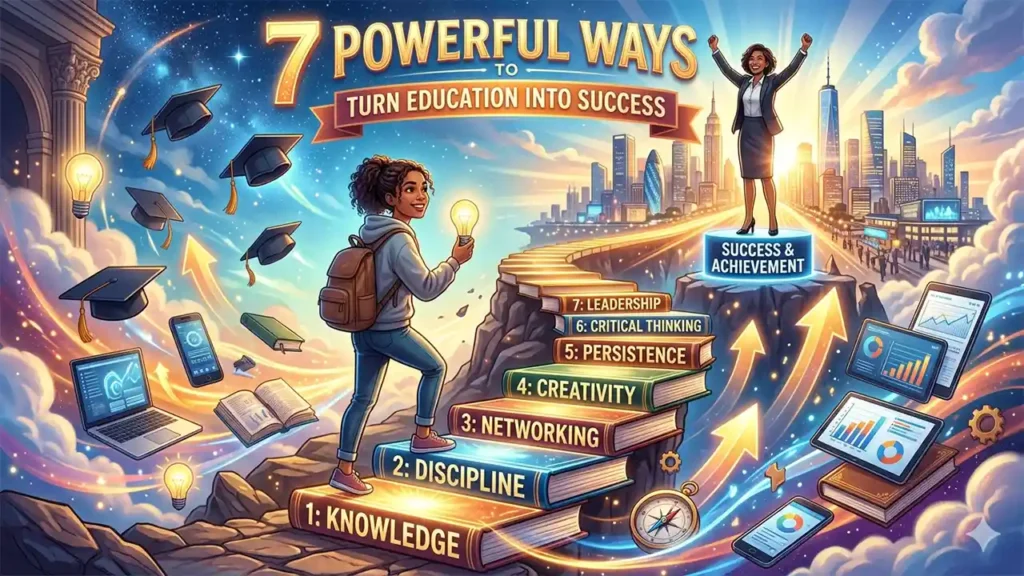
1. Build Knowledge, Then Immediately Apply It
Most people learn in the wrong order. They study, study, study, and wait until they feel “ready” before they do anything. But readiness never arrives. You learn by doing, not the other way around.
If you are learning graphic design, design something for a real business this week — even if it’s free. If you’re learning Excel, build a budget tracker for your own money or for a friend’s small shop. Real projects expose what you actually understand versus what you only think you understand. They also give you something to show. A portfolio of real work beats a certificate every time.
2. Develop Skills People Will Pay For
Not all skills are equal in the marketplace. Knowing history is valuable as a person. Knowing how to build a website is valuable as a worker. Both matter. But only one pays rent.
In Ghana right now, the skills with the shortest path to income include graphic design, web development (especially WordPress), video editing, data analysis, and digital marketing. These are not the only paths. But they are paths where demand is high, the barrier to entry is reasonable, and you can show your work without needing anyone’s permission.
You don’t need to learn all of them. One, learned well, is enough to start.
3. Stay Consistent Even When Nobody Is Watching
The hardest part of turning education into success is not the first month. It is month four, when nobody has clapped, nobody has hired you, and you are wondering whether any of this is working.
That quiet period is where most people quit. It’s also where the foundation is being laid. If you practice design for one hour every evening for six months, you will be better than 90% of beginners who started the same time as you — because most of them stopped after three weeks.
Discipline is not glamorous. But it compounds. Small, daily effort over a long period produces results that look like talent from the outside.
4. Surround Yourself With People Moving Forward
Your environment shapes you more than you think. If everyone around you treats learning as something that ended after school, that will slowly become your mindset too.
Find people who are building things. Online communities. WhatsApp groups of freelancers. A mentor who will tell you honestly when your work is not good enough yet. Being around people who are slightly ahead of you pulls you forward in ways that willpower alone cannot.
5. Use Technology as Your Accelerator
We live in a time where almost everything is learnable online, often for free. YouTube has detailed tutorials on every software you can name. Coursera and edX let you audit university courses at no cost. ChatGPT can explain concepts to you like a patient tutor.
The tools are not the obstacle anymore. The obstacle is sitting down and using them consistently. The person who watches three hours of Excel tutorials and actually opens Excel alongside them will learn more than the person who pays for a full course and never does the exercises.
6. Set Clear Goals and Move Toward Them
“I want to be successful” is not a goal. It is a wish. A goal is: “In three months, I will have designed ten sample flyers and sent them to five potential clients.” That is specific. That is measurable. That is something you can check off or fail at honestly.
Write down what you are working toward. Not ten things. One or two. Then break them into weekly actions. The simple act of writing it down and tracking it changes your behaviour more than most people expect.
7. Accept That the Path Is Not Straight
Nobody’s career looks like the brochure. You will take detours. You will apply for things you don’t get. You will try a skill and realize it is not for you. That is not failure. That is navigation.
The people who succeed are rarely the smartest. They are the ones who refused to stop. My uncle eventually ran his own small trading business for over twenty years — not because his school certificate opened doors, but because he kept learning, kept adapting, and never assumed his education was finished.
The Bottom Line
Education is a starting point. A foundation. What you build on it — through application, skill development, consistency, relationships, and stubborn persistence — is what actually determines where you end up.
If you are reading this and wondering where to start, start with one skill. Learn it. Use it. Build something small. That’s how the gap between learning and earning closes — not all at once, but one practical step at a time.
Hi, I’m Ovadia, the founder of Ovateq. I’m passionate about technology, digital skills, and helping people learn practical tools that can improve their careers, businesses, and everyday lives. Through Ovateq, I create beginner-friendly tutorials and educational content focused on Microsoft Office, digital literacy, website development, and modern tech skills. My goal is to make technology easier to understand and more accessible for everyone.