Powerful AI for Business in Ghana: Grow Faster with ChatGPT in 2026
I was at a small printing shop in Accra last month. The owner, Kwame, runs his business from a single room with two printers, a laminating machine, and a laptop…

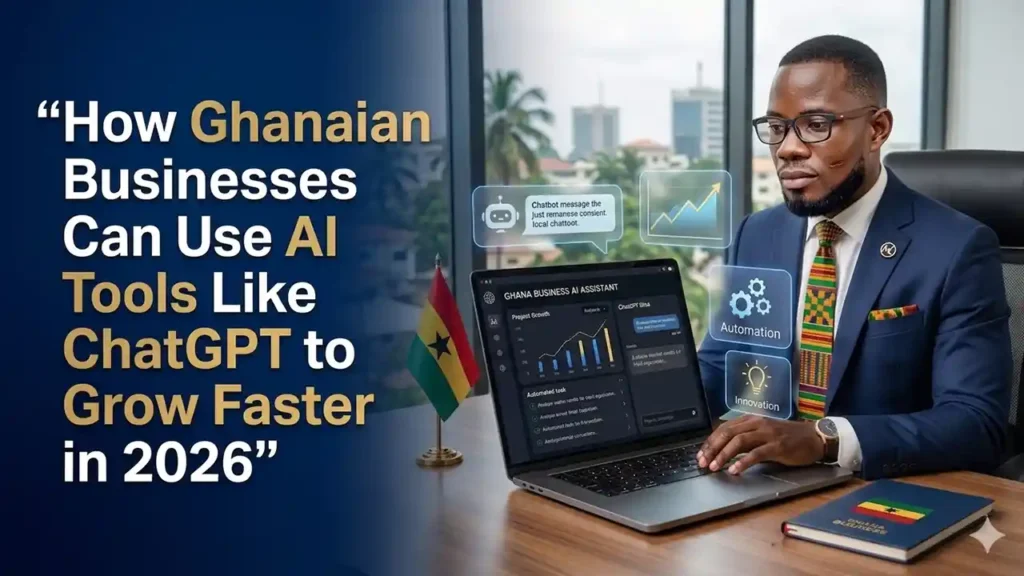
I was at a small printing shop in Accra last month. The owner, Kwame, runs his business from a single room with two printers, a laminating machine, and a laptop he bought secondhand. He told me something I haven’t stopped thinking about.
“You know what changed everything for me? ChatGPT writes my quotes now.”
He showed me. A customer messages on WhatsApp asking for 50 branded T-shirts. Kwame types a rough description into ChatGPT, and within seconds, he has a clean, professional quote with quantities, sizes, turnaround time, and pricing. He tweaks two lines, copies it, and sends it. The customer responds: “Wow, so professional. Let’s proceed.”
That is not science fiction. That is a printer in Accra using a free tool to look bigger than his shop.
If you run a business in Ghana, here is the honest truth: AI isn’t coming. It’s already here. And it’s not about replacing people — it’s about the quiet advantage of being faster, clearer, and more responsive than your competition. This guide covers the practical ways Ghanaian business owners are actually using AI right now, not the theory you read in tech blogs.
What AI for Business Actually Means (Not the Hype)
When people say “AI,” most of them picture robots or self-driving cars. That’s not what matters for you.
In practical terms, AI tools like ChatGPT, Claude, and Gemini are text-based assistants. You type a request in plain English, and they generate a response — a quote, a marketing post, a contract draft, a business plan outline. They don’t think. They predict. But they predict well enough to save hours of work every week.
For a Ghanaian business owner, this translates to one thing: you can do the work of two or three people without hiring anyone. That’s the real opportunity.
Five Ways Ghanaian Businesses Are Using AI Right Now
1. Customer Communication That Never Sleeps
Most small businesses in Ghana communicate through WhatsApp. The problem: customers message at all hours, and if you don’t respond quickly, they move on to someone who does.
Kwame at the printing shop uses ChatGPT to draft responses. A customer asks, “How much for 200 wedding invitations?” He describes what he offers, and ChatGPT produces a clean reply with pricing tiers, paper options, and delivery timelines. He edits it in under a minute and sends it. Before, he was typing everything from scratch, making typos, forgetting details. Now he looks polished every time.
You can take this further with simple WhatsApp Business auto-replies for common questions, then use AI to handle the more complex messages that need a human touch but benefit from a fast draft.
2. Marketing Content Without a Marketing Department
Most Ghanaian businesses don’t have a marketing team. They have one person — often the owner — who posts on Instagram or Facebook when they remember to.
AI changes that math. You can generate:
- Social media captions — tell ChatGPT what you’re promoting and who your audience is, and it gives you a week’s worth of posts.
- Email newsletters — draft an update for your customers in seconds.
- Product descriptions — if you sell on Jumia or Tonaton, AI writes descriptions that actually sell instead of “nice shoes available.”
The content won’t be perfect. But it’s a starting point that takes 80% of the work off your plate. You edit, you add your voice, and you post.
3. Business Documents That Look Professional
Proposals, invoices, business plans, contracts — these intimidate people who didn’t study business formally. AI doesn’t replace a lawyer, but it gets you 90% of the way there for daily documents.
I watched a caterer in Dansoman use ChatGPT to write her first proper catering contract. She described what she needed — deposit terms, cancellation policy, menu change deadlines — and it produced a clean, professional document. She had a lawyer friend glance at it, and he made only minor changes.
That’s the difference between someone who gets paid upfront and someone who chases payments for weeks because “the client changed her mind.”
4. Research and Decision-Making, Faster
Need to know what beauty products are trending in Accra? What price point works for phone accessories on Tonaton? Whether you should register your business as a sole proprietorship or a limited company?
You could spend three hours on Google, clicking through conflicting advice. Or you could ask ChatGPT for a summary, get the framework in two minutes, and then verify the details yourself. The AI gives you the starting point. Your judgment makes the final call.
5. Website and Tech Help Without a Developer
This one matters for anyone selling online. You don’t need to know how to code to improve your website or online store. AI tools can help you write better page descriptions, suggest layout improvements, and even troubleshoot basic WordPress issues.
I’ve seen students use ChatGPT to figure out why their Elementor section wasn’t displaying properly — and fix it themselves in ten minutes instead of waiting three days for a developer to respond. That’s real money saved.
The Things to Watch Out For
AI is a tool, not a replacement for thinking. Here’s what trips people up:
- Never copy and paste directly. AI writing sounds like AI writing. Customers notice. Always read it, edit it, and add your own voice.
- Don’t share sensitive information. Don’t paste your full customer list or financial records into a free AI tool. Use it for drafting, not storing private data.
- Verify everything important. AI sometimes makes up facts that sound convincing. If you’re using it for legal, financial, or medical advice, confirm with a real professional.
- It won’t replace your judgment. AI doesn’t understand your customers the way you do. It doesn’t know your local market. Use it to speed up the busy work, not to make the big decisions.
The Bottom Line
Kwame the printer didn’t take a course on artificial intelligence. He downloaded ChatGPT on his phone, experimented for a week, and found one thing it could do well — write quotes. That one thing gives him an edge over every printing shop that still types quotes manually.
You don’t need to master AI. You need to find one or two things it can do for your business, right now, that save time or make you look better to customers. Start there. The rest follows.
And if you’re still wondering whether this is worth your time — ask yourself whether your competitors are already using it. Because in Accra, Kumasi, and every major city in Ghana, they are.
Hi, I’m Ovadia, the founder of Ovateq. I’m passionate about technology, digital skills, and helping people learn practical tools that can improve their careers, businesses, and everyday lives. Through Ovateq, I create beginner-friendly tutorials and educational content focused on Microsoft Office, digital literacy, website development, and modern tech skills. My goal is to make technology easier to understand and more accessible for everyone.